What does an AI coworker cost? Pricing model, TCO and payback
An honest business case looks beyond a software subscription. What does an AI coworker cost, implementation and maintenance included, and when does it pay back?
Comparing AI pricing: not every 'AI solution' is comparable
The market for AI products in 2026 is crowded. You have copilots in Microsoft 365 (a few tens per user per month), OCR products (per document or per page), RPA platforms (per bot-hour), and agentic platforms with their own pricing. They all do something different and are therefore only loosely comparable. Anyone looking at license price alone regularly reaches the wrong conclusion.
For an AI coworker that runs a full process (invoice processing, order processing, collections, service tickets, recruitment screening) you want to look at three things: what the platform costs, what implementation costs, and what the process saves. The first two are our investment in you; the third is what you get back.
The AgentsLab AI coworker pricing model
Our pricing is deliberately simple. You pay a monthly platform fee per AI coworker plus a one-off implementation fee to set the process up. No pay-per-document, no unpredictable model costs, no expensive consulting hours outside the implementation package.
The components on our invoice:
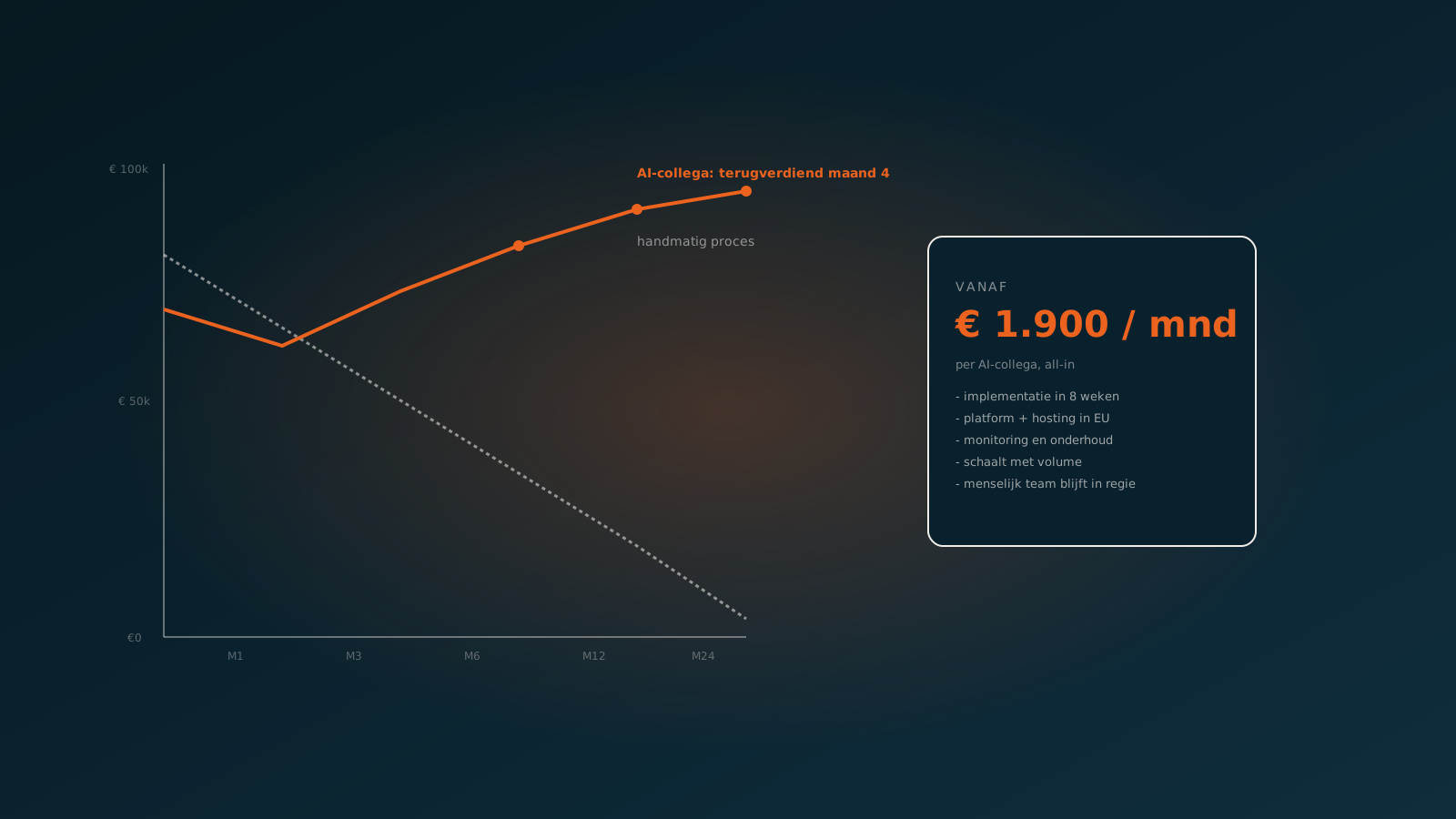
- Platform fee: fixed monthly amount per AI coworker, stepping up with volume (for example up to 5,000 cases, up to 20,000, up to 100,000 per month).
- Implementation: one-off, based on scope and integrations. Typically eight weeks from kick-off to production.
- Managed service: monitoring, maintenance and release management, moving with the platform.
- Integrations: connections to your ERP, ATS or mail system are part of implementation; new integrations later are a separate scope.
- Additional agents: every next AI coworker has its own platform fee and a smaller implementation fee because the foundation is already in place.
What an AI coworker saves in process work
An AI coworker doesn't replace people in the sense that someone has to leave; it replaces the work time that goes to process handling today. In concrete numbers: an invoice that takes ten minutes to process now takes an AI coworker thirty seconds on average. An order that now takes ten minutes drops to under half a minute. On ten thousand invoices or orders a year that adds up: one to two FTE of process work freed for knowledge work.
AI coworker payback in practice
Our average customer earns the investment back within three to five months after go-live. That's including the implementation fee, but for process work with enough volume to justify an AI coworker. Below 2,000 cases a year it becomes harder; above 10,000 cases a year it's standard. For organizations automating multiple processes sequentially, marginal payback drops further because platform costs are spread.
When an AI coworker doesn't pay back: that's when we say no
Not every conversation ends with a proposal. We say no when volume is too low for a payback case, when there's no process owner who can carry the implementation, or when the process really needs a redesign before automation makes sense. That honesty saves both sides time. Plan a Quick Scan to test whether an AI coworker fits the process and volume you have today.
Curious what an AI coworker can do for your process?
Book a no-strings Quick Scan and explore the options.
Book a Quick Scan